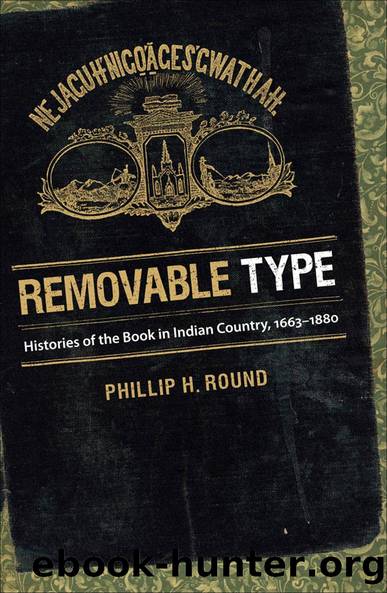
Removable Type by Phillip H. Round
Author:Phillip H. Round [Round, Phillip H.]
Language: eng
Format: epub
Tags: Social Science, Ethnic Studies, American, Native American Studies, Language Arts & Disciplines, Publishers & Publishing Industry, History, United States, General
ISBN: 9780807899472
Google: wHdmjNbaLgAC
Publisher: Univ of North Carolina Press
Published: 2010-10-11T03:57:42+00:00
Print Constitutional Publics
Although the Georgia militia destroyed the original press for the Cherokee Phoenix in 1835, the newspaper would, like its mythic masthead symbol, rise again from the ashes. In the late 1840s, the Cherokee Phoenix would be reconstituted in the Indian Territory as a more potent bicultural and consensus-based project. Other Indian newspapers soon joined the Cherokee press. The Choctaw Intelligencer was launched in 1852, printed in English and employing a Roman type orthography for Choctaw language articles.74 The Chickasaw and Choctaw Herald appeared in 1858, along with numerous printed tribal constitutions and statute laws. But the reestablished press did much more than reconstitute a public sphere of newsprint âhomeâ readers. It was instrumental in the rise of print constitutionalism among the southeastern tribes in the aftermath of removal and was thus, as Robert Warrior observes of Osage constitutionalism in particular, âan expression of the modern intellectual aspirations of a people confronting the need to transform themselves on their own terms.â75
According to Lester Hargrett's A Bibliography of the Constitutions and Laws of the American Indians (1946), more than 200 such constitutionalist publications flowed from tribal, missionary, and job presses during the period from 1828 to 1906. The five southeastern nations produced about 90 percent of these documents. These printed works are, as Hargrett rightly notes, âthe important record of an increasingly unified effort by a more or less concentrated group of Indian tribes to adjust themselves to changing conditions by means of self-government under constitutional forms.â76 Most of the printing occurred on the reestablished Cherokee press, under the guidance of John Candy, Boudinot's old protégé.
Print constitutionalism in the Indian Territory took the form of consensus building and grew out of the slow and steady negotiation of oral, manuscript, and print cultures into a full-blown Indian public. The âsociologyâ of the production of print constitutions in the Indian Territory after removal was especially intricate. Printed legal texts that originated in public councils were written first into manuscript forms that circulated for many years before being committed to print. Hargrett, for example, lists 1808 as the date when the Cherokee first began writing down laws. It took until 1821, however, for the first of these statutes to roll off a press. This first publication of the Cherokee laws was done on a job press at Knoxville, Tennessee, and was produced using a Roman alphabet syllabary. By 1827, when the Cherokee finally adopted a printed constitution, it was produced in a parallel-column bilingual edition that employed the Sequoyah syllabary.
Yet the story of the rise of printed constitutionalism in the Indian Territory is not a progressivist, Whig history. Manuscript syllabary texts continued to dominate other quarters of Native life in the Indian Territory (in medicine societies, for example, as the Swimmer Manuscript demonstrates), while printed materials appeared irregularly in both syllabary and English formats. When the Cherokee regrouped after the Trail of Tears and in 1839 assembled at Tah-le-quah in present-day Oklahoma to promote an âact of union,â they chose the elderly Sequoyah
Download
This site does not store any files on its server. We only index and link to content provided by other sites. Please contact the content providers to delete copyright contents if any and email us, we'll remove relevant links or contents immediately.
The Great Music City by Andrea Baker(32849)
Cecilia; Or, Memoirs of an Heiress — Volume 1 by Fanny Burney(32682)
Cecilia; Or, Memoirs of an Heiress — Volume 2 by Fanny Burney(32040)
Cecilia; Or, Memoirs of an Heiress — Volume 3 by Fanny Burney(32025)
We're Going to Need More Wine by Gabrielle Union(19133)
All the Missing Girls by Megan Miranda(16468)
Pimp by Iceberg Slim(14733)
For the Love of Europe by Rick Steves(14721)
Bombshells: Glamour Girls of a Lifetime by Sullivan Steve(14172)
Norse Mythology by Gaiman Neil(13497)
Talking to Strangers by Malcolm Gladwell(13487)
Fifty Shades Freed by E L James(13317)
Mindhunter: Inside the FBI's Elite Serial Crime Unit by John E. Douglas & Mark Olshaker(9463)
Crazy Rich Asians by Kevin Kwan(9375)
The Lost Art of Listening by Michael P. Nichols(7580)
Enlightenment Now: The Case for Reason, Science, Humanism, and Progress by Steven Pinker(7384)
The Four Agreements by Don Miguel Ruiz(6869)
Bad Blood by John Carreyrou(6699)
Weapons of Math Destruction by Cathy O'Neil(6419)
